Where we are
Every mature high-stakes industry grew a third-party assurance layer, and most of them started the way AI has: voluntary, paid by the assessed party, with the assessed party choosing scope. The ladder marks the year each regime first reached each stage. Tap a cell to see the milestone behind it and its source; tap a regime name for its full history.
Caveat. Dataset B is coded from secondary sources at year granularity, with primary-source verification still to do, and its trigger incidents were selected with hindsight. The lag pattern below is a description of the coded record, not a finding about how regimes behave. The ladder records first arrivals, so a one-clause rule in one state fills a cell the same way Sarbanes-Oxley does; the three views after it keep the order and the strength of each move.
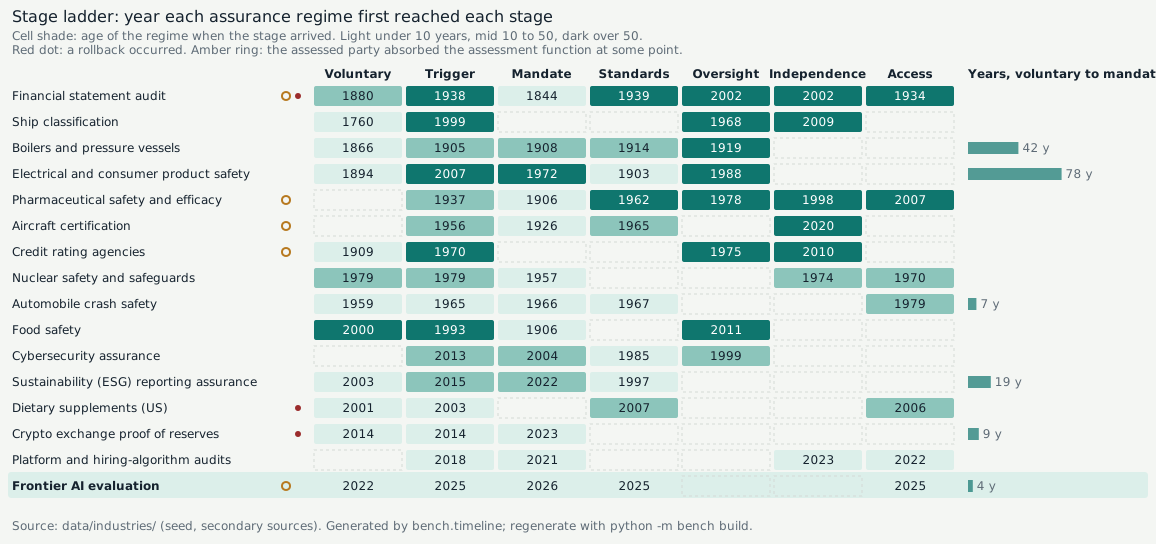
Read financial audit left to right and you get 158 years from the first mandate to the first rule separating auditors from consultants. Read the AI row and you get four. Across regimes, rules have followed public failures within a few years in the coded record; the stretch before the first failure is where a regime's shape is decided. The oversight and independence-rule columns are the ones AI has not filled. Data and method: data/industries/, bench/timeline.py, paper/.
Paths, responses, and mechanisms
Three views that keep the nuance the ladder drops. Hover or tap any glyph, point, or cell to read what it stands for and where it comes from.
The order, not the calendar
Each regime as a sequence of moves. Reversals show up in red, the assessed party absorbing the assessment function in amber. The right column ranks regimes by how closely their opening moves match frontier AI's so far, using edit distance over the sequences. Two regimes tie for nearest, the sequences are short, and the coding is coarse: a hypothesis generator, not a prediction.
Scroll sideways to see the rest of the figure.
Fast is not the same as strong
Every trigger incident paired with the next rule that followed. Most responses arrive within three years, and most are mandates or standards rather than structural changes; the two structural responses in the set are the PCAOB after Enron and lab inspection under Good Laboratory Practice after the IBT fraud. Frontier AI's two responses so far score 2 and 1. Triggers were selected with hindsight, so the speed is a property of the coded record.
Scroll sideways to see the rest of the figure.
Who pays, selects, sees, publishes, and watches
The configuration the ladder cannot show. Read the AI row against the others: the only other regime with the same five-cell pattern is dietary supplements, the regime that removed pre-market review by statute. The match is on a coarse categorical coding, so it is suggestive rather than conclusive.
Scroll sideways to see the rest of the figure.
The sixteen regimes
Sixteen assurance regimes coded as dated milestones. The path signature is the ordered sequence of moves (V voluntary, T trigger, M mandate, S standards, O oversight, I independence, A access or publication, D delegation, P payer shift, R rollback). Similarity compares each regime's opening to frontier AI's path so far.
| Regime | Path | Stages | First milestone | Similarity to AI | Jurisdiction | Who pays |
|---|---|---|---|---|---|---|
| Financial statement audit | MRVMATSDTOI | 7/7 | 1844 | 0.36 | UK/US/EU | Audited company pays the auditor; audit committee hires and fires (post-2002). |
| Ship classification | VOTI | 4/7 | 1760 | 0.22 | International/EU | Shipowner pays the classification society. |
| Boilers and pressure vessels | VTMSO | 5/7 | 1866 | 0.22 | US | Insurer employs the inspector; owner pays the insurer. |
| Electrical and consumer product safety | VSMOTM | 5/7 | 1894 | 0.33 | US | Manufacturer pays the testing lab. |
| Pharmaceutical safety and efficacy | MTMTDMSTOPIA | 6/7 | 1906 | 0.22 | US | Sponsor funds trials and, since 1992, pays user fees for review. |
| Aircraft certification | MTMSDTI | 4/7 | 1926 | 0.22 | US | Manufacturer pays for certification work, much of it delegated to its own employees. |
| Credit rating agencies | VDTOTI | 4/7 | 1909 | 0.44 | US/EU | Issuer pays since the 1970s; investor-pays subscription model before that. |
| Nuclear safety and safeguards | MAIAVTA | 5/7 | 1957 | 0.22 | International/US | Operators fund INPO; states fund IAEA and national regulators. |
| Automobile crash safety | VTMSA | 5/7 | 1959 | 0.33 | US | Insurers fund IIHS; government funds NCAP; manufacturers do not pay for ratings. |
| Food safety | MTMVTO | 4/7 | 1906 | 0.22 | US | Producer pays private certifiers; government inspection publicly funded. |
| Cybersecurity assurance | SOMOT | 4/7 | 1985 | 0.11 | International/US | Vendor or merchant pays the accredited assessor. |
| Sustainability (ESG) reporting assurance | SVTMS | 4/7 | 1997 | 0.33 | EU/International | Reporting company pays the assurance provider. |
| Dietary supplements (US) | RVTAS | 4/7 | 1994 | 0.33 | US | Manufacturer pays private verifiers; verification is voluntary. |
| Crypto exchange proof of reserves | VTRTM | 3/7 | 2014 | 0.44 | International/EU | Exchange pays the attesting firm. |
| Platform and hiring-algorithm audits | TMAIT | 4/7 | 2018 | 0.22 | EU/US | Platform or employer pays the auditor. |
| Frontier AI evaluation | VDVTSATMA | 5/7 | 2020 | ref | US/EU | Mixed: philanthropy, lab fees, government budgets. No accreditation. |